

Can a Pressure Spray Dryer be used for leather waste drying?
Hey there! I'm a supplier of pressure spray dryers, and today I want to dive into an interesting question: Can a pressure spray dryer be used for leather waste drying?
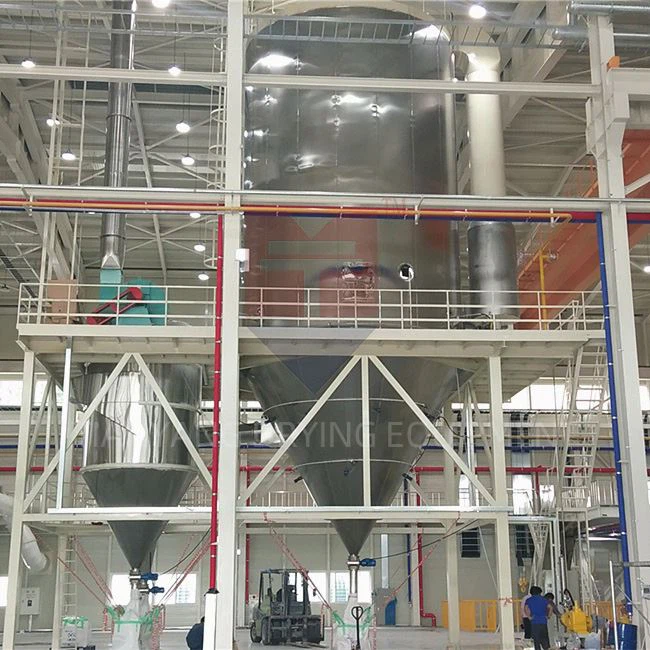
First off, let's talk a bit about what pressure spray dryers are. These machines are pretty cool. They work by atomizing a liquid feed into fine droplets and then drying them in a hot gas stream. The result is a dry powder or granules. We've got different types of pressure spray dryers in our catalog, like the Cocurrent Flow Pressure Spray Granulation Dryer and the Pressure Spray Drying Granulator Mixed Flow. Each type has its own features and advantages, but they all share the basic principle of turning liquids into dry solids.
Now, let's get to the main question - leather waste drying. Leather waste is a common by - product in the leather industry. It contains a significant amount of moisture, and getting rid of this moisture is crucial for further processing or disposal. There are several reasons why we might want to dry leather waste. For one, it can reduce the volume of the waste, making it easier and cheaper to transport. Secondly, dried leather waste can potentially be recycled or used as a raw material in other industries, like the production of animal feed or as a filler in some composite materials.
So, can our pressure spray dryers handle leather waste? Well, there are a few factors to consider.
Advantages of Using Pressure Spray Dryers for Leather Waste Drying
-
High - speed drying: Pressure spray dryers are known for their fast drying capabilities. The atomization process creates a large surface area for the moisture in the leather waste to evaporate quickly. This means that we can dry a large amount of leather waste in a relatively short period of time, which is great for industrial - scale operations.

-
Uniform drying: The spray drying process ensures that the leather waste is dried evenly. Each droplet is exposed to the hot gas stream in a similar way, resulting in a consistent moisture content throughout the dried product. This is important because non - uniform drying can lead to problems in further processing, such as uneven quality of the recycled materials.
-
Flexibility in particle size: We can control the particle size of the dried leather waste by adjusting the atomization parameters. This is useful depending on the end - use of the dried waste. For example, if the dried leather waste is going to be used as a filler in a composite material, we might want a specific particle size for better integration with the other components.
-
Automation potential: Pressure spray dryers can be easily automated. This means that once the process is set up, it can run continuously with minimal human intervention. This reduces labor costs and also improves the consistency of the drying process.
Challenges of Using Pressure Spray Dryers for Leather Waste Drying
- Viscosity issues: Leather waste is often in a slurry or semi - solid form, and it can have a relatively high viscosity. High - viscosity materials can be difficult to atomize properly in a pressure spray dryer. If the leather waste is not atomized well, it can lead to uneven drying, clogging of the nozzles, and a lower quality of the dried product. To overcome this, we might need to pre - treat the leather waste to reduce its viscosity, such as by adding a suitable solvent or using a mechanical mixing process to break down the large particles.
- Odor and emissions: Leather waste can have a strong and unpleasant odor, especially when it is being dried. During the drying process, some of the volatile organic compounds (VOCs) in the leather waste can be released into the air. This not only creates an environmental and health hazard but also requires proper odor - control and air - treatment systems to be installed along with the pressure spray dryer.
- Heat - sensitive components: Leather contains some heat - sensitive components, such as proteins. Excessive heat during the drying process can cause these components to denature, which can affect the quality of the dried leather waste and its potential for recycling. We need to carefully control the drying temperature and the residence time of the leather waste in the dryer to avoid over - heating.
Solutions to Overcome the Challenges
- Viscosity management: As mentioned earlier, pre - treatment of the leather waste is key. We can use chemical additives to reduce the viscosity or mechanical methods like grinding or homogenization. Additionally, we can choose a pressure spray dryer with a high - pressure nozzle that is designed to handle more viscous materials.
- Odor and emission control: We can install odor - control systems, such as activated carbon filters or scrubbers, to remove the unpleasant odors and VOCs from the exhaust air. These systems can be integrated into the overall design of the pressure spray dryer setup.
- Temperature control: Advanced control systems can be used to precisely regulate the temperature of the hot gas stream in the pressure spray dryer. We can also use a two - stage drying process, where the initial drying is done at a lower temperature to avoid denaturing the heat - sensitive components, and then a final high - temperature stage can be used to achieve the desired moisture content.
Case Studies
There aren't as many well - documented case studies on using pressure spray dryers for leather waste drying as there are for other applications. However, in some small - scale experiments, the results have been promising. For example, a small leather factory tried using a pressure spray dryer to dry their leather waste. They were able to reduce the moisture content of the waste from around 70% to less than 10% in a relatively short time. The dried leather waste was then used as a filler in a rubber - based composite material, and the quality of the composite was found to be satisfactory.
Conclusion
In conclusion, pressure spray dryers have the potential to be a great solution for leather waste drying. While there are some challenges to overcome, with the right pre - treatment, equipment design, and control systems, we can effectively dry leather waste using these machines. The advantages of high - speed drying, uniform drying, and flexibility in particle size make them a strong candidate for industrial - scale leather waste drying operations.
If you're in the leather industry and are looking for a reliable solution for leather waste drying, our pressure spray dryers could be the answer. We have a team of experts who can help you customize the drying process according to your specific needs. Whether it's adjusting the atomization parameters, dealing with viscosity issues, or setting up the odor - control systems, we've got you covered.
If you're interested in learning more about our pressure spray dryers and how they can be used for leather waste drying, don't hesitate to reach out. We're always happy to have a chat, answer your questions, and discuss potential solutions for your leather waste drying needs. Let's work together to make your leather waste management more efficient and sustainable.
References
- "Industrial Drying Technology" by Arun S. Mujumdar.
- "Leather Science and Technology" textbooks for information on leather waste properties.
- Industry reports on leather waste management and recycling.